What to put on a wedding invitation: a complete checklist
What must go on a wedding invitation, what can wait for a details card or your website, and what to leave off. Includes a checklist, a proofreading routine, and copyable samples.
A wedding invitation has one job: to tell a guest who is inviting them, to what, when, and where, and how to answer. Everything else is a question of where it belongs. Some things go on the card. Some go on a second card. Many are better on a web page that guests can open when they need it.
This is a checklist for deciding. It sorts what to include, what to move, and what to leave off, with samples you can copy.
If a guest would need it to say yes, it belongs on the invitation. If they will need it later, it belongs on a page.
Names in the samples are invented. For how to phrase each line, see the wedding invitation wording guide. The wedding invitations can carry the finished words.
The essentials: what every invitation needs
Without these, a guest cannot answer or arrive. Include all of them.
- Who is inviting. The hosts, when someone other than the couple is hosting.
- The invitation itself. One sentence that asks guests to come.
- The couple’s names. Spelled as they spell them.
- The date. The day, the date with the month in words, and the year.
- The time. And the time zone, if any guests are travelling or joining online.
- The place. The venue, the city, and the country if guests are coming from abroad.
- How to reply, and by when. A method and a date written in full.
If your card has these seven, it works. Everything below makes it kinder, clearer, or more complete.
Helpful additions: include if they apply
These help guests plan. Add the ones that apply to your wedding, and keep each to a line.
- The reception. If it is at a different place or time, say so. “Dinner and dancing to follow” is enough if it is at the same venue.
- Who is invited. If children or plus-ones are welcome, say it. If they are not, say that too.
- Dress. One plain line, such as “Formal attire” or “Traditional dress welcome”. Add a gloss for guests who may not know the term.
- Other events. A welcome dinner, a tea ceremony, a rehearsal for guests, or a farewell brunch. Give each its own line.
- Where to find more. A web address or a short link to a page with directions, hotels, and the schedule.
- A contact. Someone who can answer questions, with a phone number or message address.
The reply details
A reply line works best when it names three things: the action, the place, and the date. “Please reply on our page by Sunday, 15 August 2027” covers all three. On a printed card, add the web address or the return address. Avoid “RSVP” on its own, since some guests do not know the abbreviation. The RSVP guide covers how to collect and follow up.
Dress and the day’s details
Keep dress to a line, and use ordinary words. “Black tie” means different things in different places. “Formal, with long dresses or suits” is clearer. If the venue has a rule, such as covered shoulders, shoes removed, or a long walk over uneven ground, tell guests.
The extra cards: what belongs on a second piece
A formal suite often has more than one card. Digital invitations can do the same job with a few sections on the page. Use a second piece for anything that would crowd the main invitation.
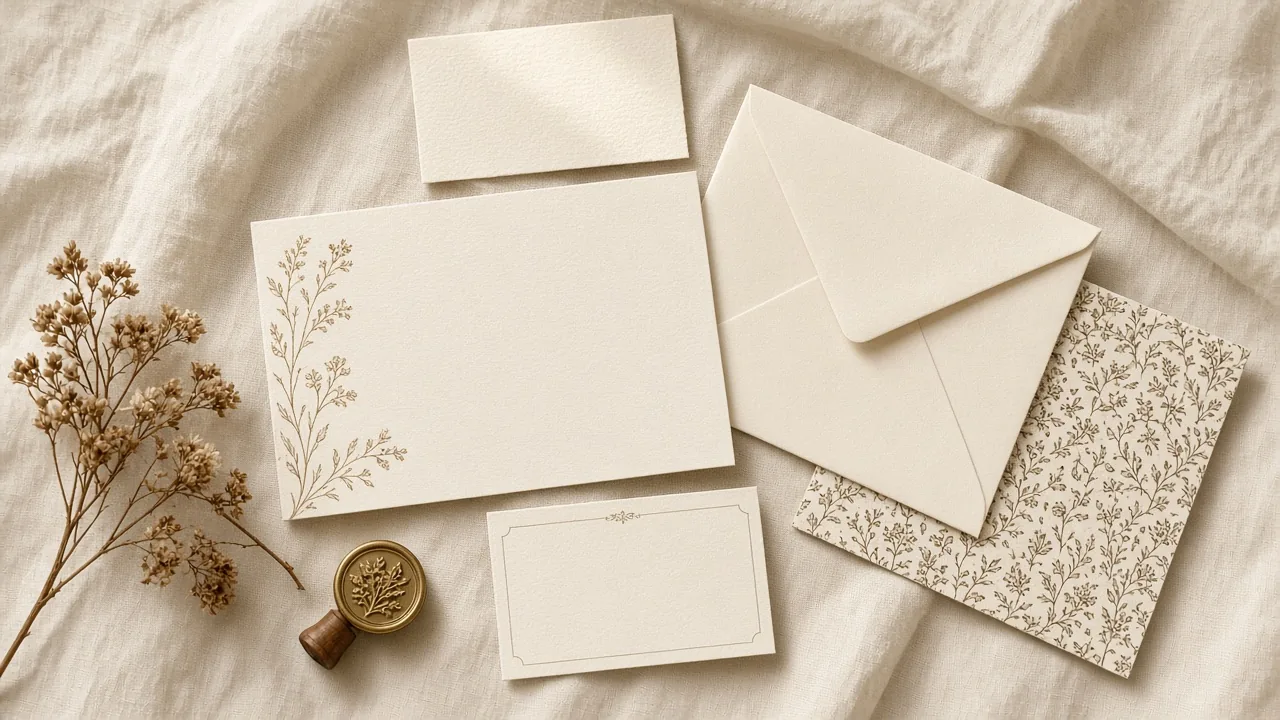
- The details card: the schedule, directions, hotels, parking, and the website.
- The reply card: names, a yes or no, dietary needs, and the date to return it.
- The accommodation card: hotel names, a booking code, and the date the block closes.
- The map or the transport note: how to get there, and when shuttles run.
- A note on the day: a short paragraph for guests, such as a cultural note about the ceremony.
If the details card runs onto a second side, move it to a web page instead. A guest can look at a page on the morning of the wedding. A card lost in a drawer cannot be updated.
What to leave off
A crowded invitation is a hard one to read. These belong elsewhere, or nowhere.
- Gift requests and registry details. Share them on your website, if at all. Customs vary, and the card is for the invitation. The traditions guide explains why.
- Long stories. A short note of thanks is welcome. A paragraph about how you met belongs on the website.
- A hashtag, a playlist, or a slogan. If you want one, put it on the website.
- Instructions that sound like rules. “No phones” and “No plus-ones” can be said kindly, on the page, in a sentence.
- Full directions. A map link is clearer than a paragraph of turns.
- Anything unconfirmed. If a time or a venue might change, say it will be confirmed, and give a date.
Gifts and registries
It is common to ask nothing on the invitation. If you want to say something, put one gentle line on your website. In many places a money gift is the custom, and in others a gift registry. Do not assume either on behalf of the guests.
A layout that works
Most invitations follow a simple order. Keep the lines that apply, and drop the rest.
Hosts, if they are not the couple
The invitation line

The couple’s names

The day, the date, and the year
The time, with the time zone if needed
The venue, the city, and the country

The reception line, if it is separate
Dress, in one line

How to reply, and the date
Together with their families

Amara Shah
and
Leo Berg

invite you to celebrate their wedding

Saturday, 12 June 2027
at four o’clock in the afternoon
The River Room, Lisbon, Portugal

Dinner and dancing to follow
Formal attire

Kindly reply on our page by Sunday, 16 May 2027.
On a digital invitation, the same order applies, with more room. Put the essentials at the top, where a guest sees them without scrolling, and let the details sit beneath.
Digital invitations and the page
A digital invitation removes the pressure on space. The invitation can hold the card, the schedule, the map, and the reply on one page. That is a gift, and a trap. A page that holds everything at once can overwhelm. Keep the top simple and let the rest unfold.
- The top of the page carries the essentials: names, date, time, place.
- The reply sits directly beneath, or is a clear button.
- The schedule, the travel details, and the dress notes follow.
- The extras, such as stories, photos, and gifts, sit at the end.
With Sealed RSVP, the invitation and the reply live on one page that guests open from a link. If you are weighing formats, read digital vs paper wedding invitations.
Proofread before you send
Mistakes in a wedding invitation are common, and they are hard to fix once they are sent. A quiet routine catches most of them.
- Read it aloud, slowly, line by line.
- Check every name against the person’s own spelling, including accents and titles.
- Check the date against a calendar. Make sure the weekday and the date agree.
- Check the time and the time zone, and whether it is morning or evening.
- Open every link, and check that every address works.
- Ask two people who have not seen it before to read it and tell you the date, the place, and how to reply.
- Send it to yourself first, on a phone, and read it as a guest.
If a guest could tell you the date, the place, and how to reply after one reading, the invitation is done.
Questions couples ask
What information must be on a wedding invitation?
The hosts if they are not the couple, an invitation line, the couple’s names, the date, the time, the place, and how and when to reply. Everything else can go on a second card or a web page.
Should I put the dress code on the invitation?
Yes, in one plain line, if it matters. Use ordinary words rather than a label that only some guests know. Add a note about anything the venue requires.
Do I need to say that children are not invited?
Yes, if they are not. Say it kindly on the invitation or the page, before guests make plans. If a few children are invited, name them.
Should I put registry information on a wedding invitation?
Usually not. Put it on your website, with one gentle line. Customs differ across places and families, so keep it optional.
How much information is too much?
If the card feels crowded, move the extras to a details card or a web page. The invitation should be readable in a few seconds, and the page can hold everything else.
List the essentials first, add only what guests need to plan, and move the rest to a page. Browse the wedding invitations when you want one.