Digital vs paper wedding invitations: how to choose
An honest comparison of digital and paper wedding invitations: what each does well, where each falls short, and how many couples combine them so every guest is included.
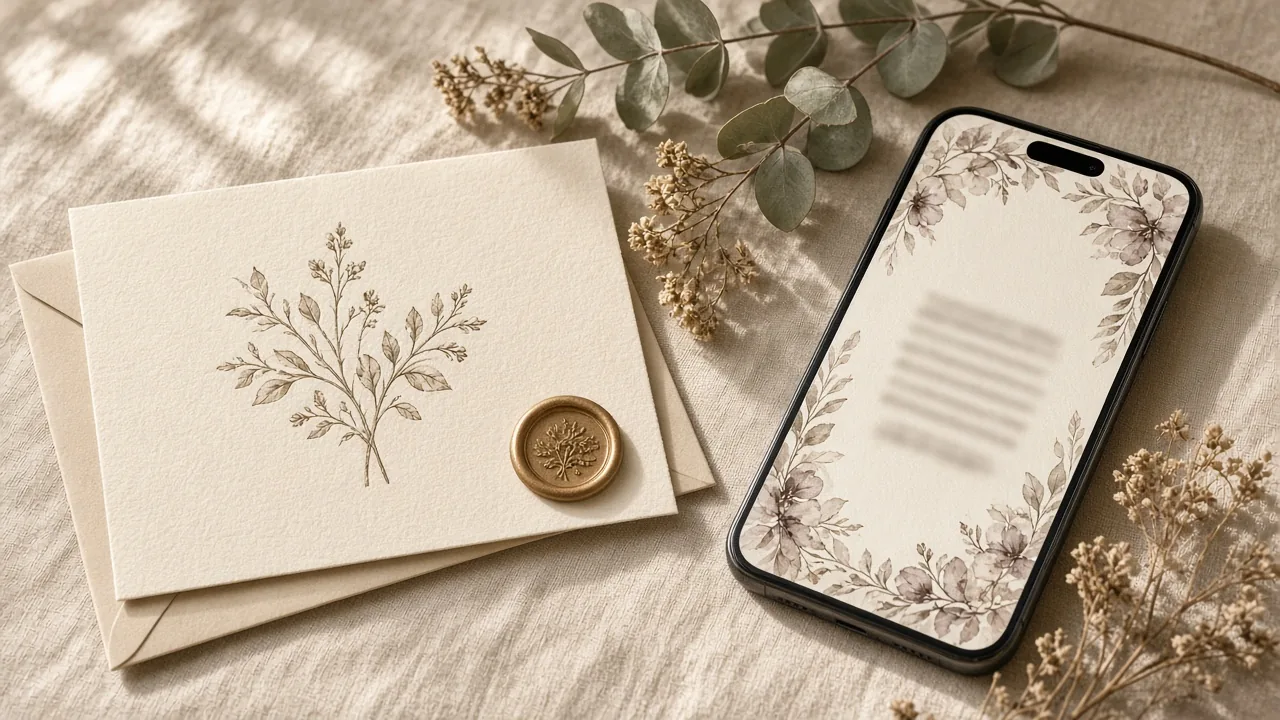
There is no winner in the digital versus paper question. There is only the one that fits your guests, your timeline, and the kind of wedding you are having. Plenty of couples choose both, and plenty regret choosing only one without thinking about who would receive it.
This guide compares them on the things that matter: cost, speed, replies, guests abroad, accessibility, and the keepsake. Then it shows how to pick, or how to combine them.
Choose the format your guests can use easily. Then make it look like you.
Names in the samples are invented. For the words themselves, read the wedding invitation wording guide. When you are ready to send, the wedding invitations can carry them as a digital page.
What paper invitations do well
A printed invitation is something people hold, prop on a shelf, and keep. It marks the occasion before the day arrives, and it suits families who treat the card as part of the ceremony.
- It feels formal. A thick card with a seal tells guests that the day matters.
- It reaches guests who are not online. Older relatives and guests with limited internet can read it without help.
- It is a keepsake. Many guests tuck it in a drawer, and many couples keep one for life.
- It can follow a tradition. In some families the card is delivered by hand, with sweets or a visit. Paper fits that custom naturally.
- It does not depend on a link. No screen, no signal, no password.
Where paper falls short
- Printing, envelopes, and postage add up, especially across borders.
- Post can be slow or unreliable. International post may take weeks, and some destinations lose mail.
- Changes mean a second print run, or a separate note.
- Replies come back by post, if at all, and you have to enter them yourself.
- Printing takes time, so the design and the guest list must be final earlier.
What digital invitations do well
A digital invitation is a page or a message that a guest opens on their phone. It can hold the words, the map, the schedule, and the reply in one place.
- It is fast. You can send it the moment the date is set, and guests have it in seconds.
- It can be corrected. A change of time, a different venue, or a new detail updates for everyone.
- It makes replying easy. The answer sits beside the invitation, and you see it as it comes in.
- It reaches guests anywhere. Distance and borders do not change the delivery.
- It costs less per guest. You do not print or post one for every household.
- It uses less paper. For couples who care about that, it is a real consideration.
Where digital falls short
- Some guests will not open a link, or will not trust it. Older relatives may need a printed copy or a phone call.
- It is easier to ignore. A message can sink under others in a busy inbox.
- It carries less ceremony unless the design is careful.
- It depends on the right addresses. A mistyped number or email means a guest never sees it.
- There is no object to keep, unless you also print something small.
Cost, speed, and effort side by side
Here is how the two compare on the things couples ask about most.
- Cost: digital is usually cheaper per guest, and the gap widens with the size of the guest list and the distance the post travels. Paper costs more, and a fine suite with envelope liners, seals, and a ribbon can cost much more.
- Speed: digital is immediate. Paper needs printing and delivery, and delivery abroad can take weeks.
- Replies: digital collects them for you. Paper needs a card, a stamp, and someone to enter the answers.
- Changes: digital updates in minutes. Paper needs a reprint or a separate message.
- Keepsake value: paper wins, unless you print a small card as well.
- Reach: paper reaches guests who are offline. Digital reaches guests who are far away.

Guests near and far
Distance changes the answer more than taste does. A wedding where most guests live in one city can send paper by hand and enjoy the ritual. A wedding with guests in five countries is a different job.
When guests live abroad
International post is slow, and its speed varies from one country to another. A card that takes ten days to one address may take a month to another. If your guests are spread out, a digital invitation lets everyone see it on the same day. You can still send a printed card afterwards, as a keepsake, once you know the replies.
It also helps with the time and the date. A digital page can show the wedding time in one zone, with the zone written out, and give each guest the same facts. Read the timing guide for how early to send.
When guests are in the same community
When most guests belong to one family or community, in-person invitations can matter as much as the card. A visit with sweets, a phone call from an elder, or a card handed over personally can tell a guest they are wanted. If that is your custom, keep it. Send the digital link after, so the visit still comes first. The traditions guide has more on how this varies.
Accessibility and inclusion
A good invitation is one that every guest can read and answer. A few simple choices help whichever format you use.
- Readable text. Choose a size and a contrast that older eyes can read. A delicate script on a pale card is lovely and hard to read.
- Plain language. “Please reply” is clearer than a code word.
- Screen readers. A digital page should use real text, not a picture of text, so a screen reader can read it aloud.
- Another language. If many guests read another language, repeat the key facts in both.
- A person to call. Name a family member or friend who can answer questions and take replies by phone.
Why many couples use both
A hybrid is often the best answer. Send a digital invitation to everyone, with the reply built in, and print a few cards for the people who will treasure them or cannot open a link.
- Digital for all, paper for some: the reply stays on the page, and grandparents and close family get a card.
- A paper card with a link: print a simple card with a web address, so the reply is still online.
- Digital first, paper later: send the link when the date is set, then post a keepsake card once you know who is coming.
- A digital save-the-date, a paper invitation: guests plan early, and the formal card arrives with the ceremony of paper.
Kindly reply by Sunday, 15 August 2027
at the web address on the back of this card,
or ask Aunt Ruth, whose number is on the back.
That last line is worth the space. A guest who cannot use the link is never left without a way to say yes.

How to choose
Ask four questions and the answer usually appears.
- Where do your guests live? Many countries or one city? The more spread out, the more digital helps.
- How comfortable are they online? If most are, digital works. If a quarter are not, plan a printed copy or a helper.
- How soon do you need replies? Digital collects them faster and in one place.
- How much does the keepsake matter to you? If it matters a great deal, add a printed card even if the main invitation is digital.
If you cannot decide, go digital for the invitation, and print a few cards for the people who matter most to you. You can add the card later, but you cannot unsend a late link.
Digital invitations with Sealed RSVP
With Sealed RSVP, the invitation and the reply live on one page that guests open from a link. That keeps the words, the details, and the answer together. The page can carry the same wording you would print, which makes the hybrid approach easy: share the link, and print a card with the same facts for guests who want one. For managing the answers, see how to manage wedding RSVPs online.
Mistakes to avoid
- Choosing a format without thinking about the guests who cannot use it.
- Printing the invitation before the guest list is final.
- Sending a link with no word of explanation to guests who do not recognise the sender.
- Using a numeric date that two countries would read differently.
- Forgetting to name a person who can help guests reply by phone.
- Assuming everyone will find a message in a crowded inbox.
Read it once as the guest least likely to use a smartphone. If they could still say yes, you have chosen well.
Questions couples ask
Are digital wedding invitations acceptable?
Yes. They are widely used, and many families now prefer them. Etiquette depends on the family and the community. If your guests expect a printed card, add one, or call the relatives who matter most.
Are digital invitations cheaper than paper?
Usually, yes. You do not print or post one for every household, and the saving grows with the guest list and the distance. A basic printed card can also be inexpensive, and a luxury suite can cost much more.
How do I invite guests who are not online?
Send them a printed card with a phone number or a helper’s name on it, or ask a relative to take their reply by phone and enter it for them.
Can I send both a digital and a paper invitation?
Yes, and it is a popular choice. Send the digital invitation to everyone for the reply, and print cards for close family or as keepsakes.
Which is better for guests living in different countries?
Digital is usually better. Everyone gets it on the same day, you avoid slow international post, and replies come back to one place.
Pick the format your guests can use, then add anything that makes it feel like yours. Browse the wedding invitations when you want the page.