When to send wedding invitations and save-the-dates
A clear timeline for save-the-dates, invitations, and RSVP deadlines, plus what changes when guests travel, when the date follows a lunar or religious calendar, or when families invite in person.
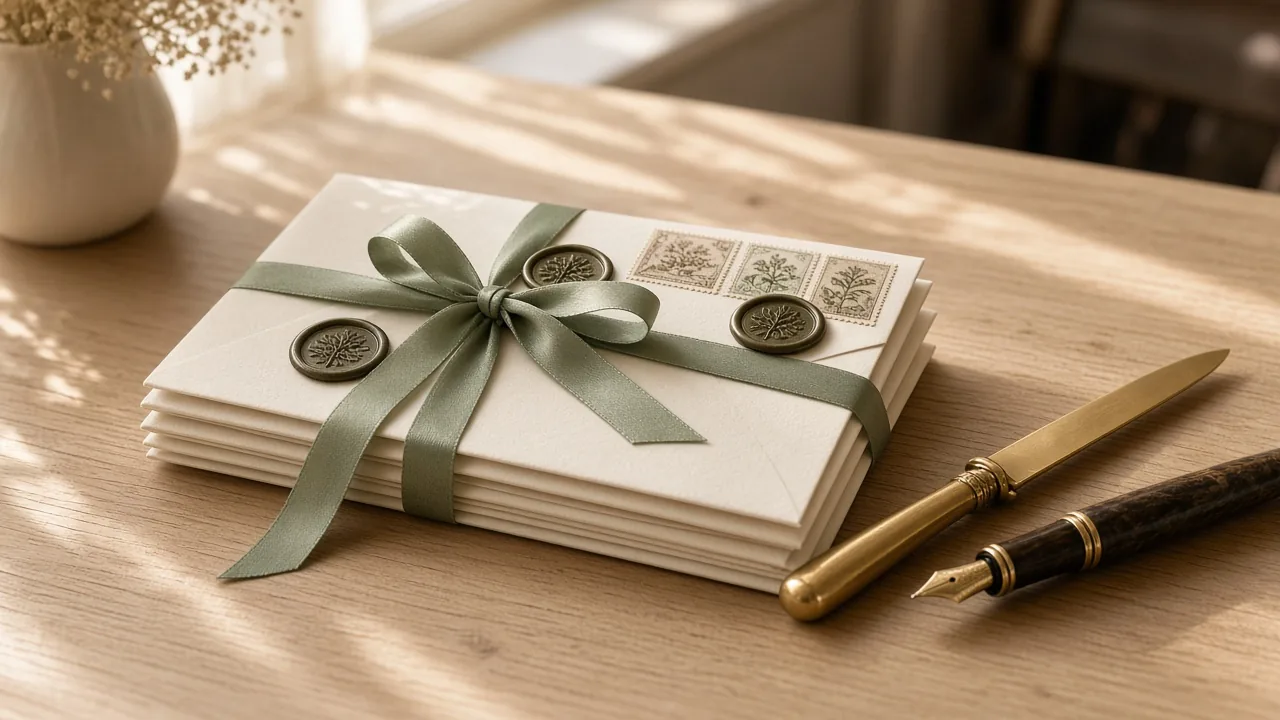
The right time to send wedding invitations depends on one thing more than any rule: how far your guests have to come. People who live ten minutes away can answer in an afternoon. People who need leave from work, a flight, or a visa need months.
This guide gives you a timeline you can count back from, then shows what to change for travelling guests, shared holidays, and customs that run on a different calendar.
Send the save-the-date when guests need to plan. Send the invitation when they can answer.
Ranges below are guides, not laws. Names in the samples are invented. Once the dates are set, the wedding invitation wording guide helps with the words, and the wedding invitations can carry them.
The short answer
Count back from the wedding day. These ranges suit most celebrations.
- Save-the-dates: six to eight months before for a local wedding, eight to twelve months before when guests travel, and a year or more for a destination wedding.
- Invitations: six to eight weeks before for local guests, eight to twelve weeks when guests travel within the region, and three to six months for a destination wedding or when guests may need a visa.
- RSVP deadline: three to four weeks before the wedding, or earlier if your caterer or venue needs final numbers sooner.
- Reminder to late repliers: a week after the deadline, one gentle message each.
- Final details: one to two weeks before, with arrival times, directions, and anything that changed.
If you are not sure which row applies, pick the longer one. A guest who hears early can still say yes. A guest who hears late often cannot.
What a save-the-date is for
A save-the-date is not an invitation. It tells people the date and the place so they can protect them. It does not ask for an answer, and it does not promise a place at the table unless you say so.
When you really need one
- Guests will fly, take a long train ride, or drive for hours.
- The wedding falls in a busy season, a long weekend, or a school holiday.
- The celebration lasts more than one day, or has more than one event.
- Some guests may need a visa, time off work, or care for a child or an elder.
- The guest list includes people in several time zones.
When you can skip it
For a small wedding close to home, a save-the-date can be one more thing to send twice. Send the invitation earlier instead, at ten to twelve weeks, and say so in a short note: “Details are inside, and the reply link is open now.”
What goes on it
Keep it small. The couple’s names, the date with the month written out, the city and country, and a line saying a formal invitation will follow. Add a website or a reply link if you already have one, and tell guests if the guest list is limited. If you mention a hotel block, say it is optional.
Save the date

Maya Okafor
and
Lucas Almeida
are getting married

Saturday, 18 September 2027
Lisbon, Portugal

A formal invitation will follow.
Save the date

Priya Raman and Jonas Weber
Saturday, 22 May 2027
Lake Como, Italy

We are inviting you for the whole weekend, 21 to 23 May 2027.
Travel details and the invitation will follow in February.
A timeline you can count back from
Here is the order of events for a wedding on a Saturday. Count back from your own date and move each line to fit.
- Nine to twelve months before: choose the date and the venue. Draft the guest list, and mark who will travel.
- Eight to ten months before: send save-the-dates to guests who need to plan travel, and to everyone if the wedding falls in a busy season.
- Four to five months before: finish the website or the digital invitation, test it on a phone, and check every name against the guest list.
- Ten to twelve weeks before: send invitations to guests who are travelling a long way. Local guests can wait two or three weeks longer.
- Six to eight weeks before: everyone else has the invitation by now. Check that nobody has been missed.
- Three to four weeks before: the RSVP deadline. Send a single reminder to people who have not answered.
- One to two weeks before: confirm final numbers with the caterer and the venue, and send guests a short note with the day’s plan.

How the timing changes with the kind of wedding
A local wedding
Most guests can decide quickly. Send invitations six to eight weeks before and ask for a reply two to three weeks ahead of the day. If guests need to book time off, add a save-the-date or a short message in the group chat.
Guests travelling in the region
Allow eight to twelve weeks. Trains and flights get dearer as the date nears, and people want to keep their weekend free before they buy. Share the nearest airport or station early, even before the invitation.
Guests flying in from abroad
Send a save-the-date at least eight to twelve months ahead. Send the invitation four to six months before, particularly when guests may need a visa letter. Write the city and the country, and give the time with the time zone. The destination wedding invitations guide covers this in more depth.
A multi-day wedding
Some weddings run over several days, with a welcome dinner, a ceremony, and a farewell lunch. Tell guests the whole shape in the save-the-date, then list each event with its own time in the invitation. A guest who only learns about day two on the night before will not have planned for it.
A wedding with guests joining online
If some guests will watch on a screen, give them the same notice as everyone else and list the time in their time zone, or at least in your own with the zone written out. “15:00 Central European Time” is something a guest in Seoul or Toronto can convert in a moment.
When the calendar is not the same for everyone
A date that is perfect for you may be a hard one for part of your guest list. Check before you print, and ideally before you book.
Religious and cultural calendars
Some families choose a wedding date by an auspicious calendar, a lunar date, or the days when a place of worship is free. Some dates are closed to weddings altogether in certain traditions, such as the days of Lent for some Christian communities, Ramadan for many Muslim families, or the days around certain festivals. Dates for these shift each year, so check them against the year you are marrying in, not the year you last looked.
When a date is fixed by a calendar, tell guests early. Families who plan a wedding by that calendar often start months before the printer is booked, and a save-the-date can follow the date as soon as it is settled.
School holidays, public holidays, and peak travel
School terms and public holidays differ across countries, and the Northern and Southern hemispheres sit on opposite seasons. A summer wedding in June is a school-holiday event in some places and a term-time one in others. If a large share of your guests are parents, look at their calendars. A holiday weekend may mean cheap family travel, or it may mean the only weekend flights are full.
Invitations that are delivered in person
In many communities an invitation is a visit before it is a card. A family may call on relatives, bring sweets, or ask elders to attend in person, and the printed or digital invitation follows. If that is how your family does it, plan the visits first. Send the digital invitation after, so nobody learns about the wedding from a link before they hear it from you.
Digital invitations and timing
A digital invitation can go out faster than a printed one, and it can be corrected after it is sent. That makes it a good choice for a late change of venue or time. It does not mean you can send it late. Guests still need weeks, not days, and the RSVP deadline should still sit three to four weeks before the wedding.
With Sealed RSVP, the invitation and the reply live on the same page, so you can send the save-the-date as a link too and update it into the full invitation later. If you want to compare formats, read digital vs paper wedding invitations. For the replies themselves, see how to manage wedding RSVPs online.

Setting the RSVP deadline
The RSVP deadline is the date that matters most to you, and the one guests notice least. Set it three to four weeks before the wedding, or whenever your caterer needs final numbers, whichever is earlier. Write it out in full, “Sunday, 15 August 2027”, and repeat it on the website.
Then add a quiet buffer. Set your guests’ deadline a week before the date your caterer needs final numbers. Some guests will always reply late, and that week gives you time to ask them once without turning it into a chase.
Please reply by Sunday, 15 August 2027
using the link on this page.
Hello Sam. We are finalising numbers this week and have not yet heard from you. Could you let us know by Friday, 20 August 2027, whether you can come? Thank you.
Common timing mistakes
- Sending the invitation without a save-the-date when most guests are travelling.
- Using a numeric date. 06/07/2027 is June in some countries and July in others.
- Giving a time without a time zone to guests who are joining from another country.
- Setting the guests’ RSVP deadline on the same day the caterer needs numbers, with no buffer for stragglers.
- Sending invitations in waves without telling the people who are waiting, so they feel less valued.
- Forgetting that your date may fall on a holiday, a fast, or a festival for part of your guest list.
Read the timeline once as a guest in another country. If you could plan a trip from what you were sent, the timing works.
Questions couples ask
How far in advance should wedding invitations be sent?
Six to eight weeks for a local wedding, eight to twelve weeks when guests travel within the region, and three to six months for a destination wedding. If guests may need a visa, lean towards the longer end.
When should save-the-dates be sent?
Six to eight months before for a local wedding, eight to twelve months before when guests travel, and a year or more for a destination wedding. If your guests are mostly local, you can skip them and send the invitation earlier.
Do I need to send a save-the-date and an invitation?
Not always. A save-the-date helps when guests travel, when the date is in a busy season, or when the celebration runs for several days. For a small wedding close to home, one early invitation can do both jobs.
What should the RSVP deadline be?
Three to four weeks before the wedding, or the date your caterer and venue need final numbers, whichever is earlier. Write it out in full, and say how to reply.
Is it too late to send invitations four weeks before the wedding?
It is late, but not hopeless for a local wedding. Send them now, call anyone who needs to travel, and ask for replies within a week. A digital invitation helps because guests can answer straight away.
Pick the date your furthest guest needs, count back from it, and write the timeline into your calendar. When you are ready for the page, browse the wedding invitations.