Christening invitation wording: inviting guests to a baptism or naming day
A clear guide to christening and baptism invitations, with wording samples, timing, and etiquette, and a respectful look at related naming traditions around the world.
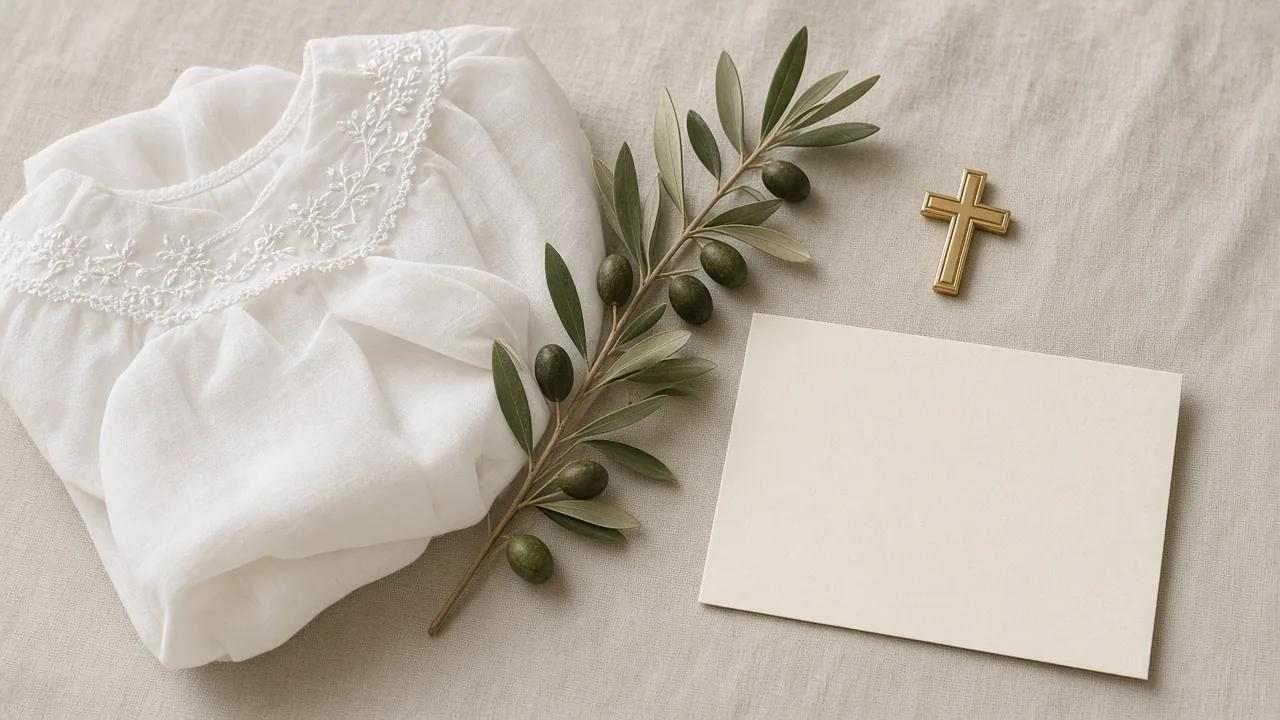
A christening invitation has two jobs, and they are easy to mix up. Some guests are being invited to a service. Some are being invited to a meal afterwards. Many are being invited to both. The card should say which, in ordinary words, so that a guest knows whether to find a place of worship, a house, or both.
The words “christening” and “baptism” are close, and people use them differently. Baptism is the rite of washing with water as a sign of Christian initiation. Christening is often used, especially in Anglican and everyday British English, for a service in which a child is baptised and named. In many Catholic, Orthodox, and Protestant churches, families simply say “baptism.” This guide uses the words families actually put on invitations, and it does not assume one church’s pattern is universal.
Say whether guests are invited to the service, to the gathering afterwards, or to both. Then give the times and the places in full.
Names in the samples are invented. The christening invitations can carry the wording, with replies on the same page. If you are also planning a gathering before the birth, see baby shower invitation wording.
What to put on the invitation
- The child’s name. The name that will be used at the service, including any baptismal name if the family wants it written out.
- The parents’ names. And the hosts, if someone else is giving the lunch.
- What guests are invited to. A christening, a baptism, a dedication, or a naming, plus any reception, lunch, or tea.
- The date. Month in words.
- The time of the service, and the time of anything that follows. They are often not the same.
- The place of worship, and the place of the gathering. Full names, the city, and the country if guests travel.
- How and when to reply. You may only need replies for the meal, but it is still wise to ask.
- Any note the place requires. Covering the head or shoulders, modest dress, or arriving early to be seated.
Godparents, a long family list, parking, and gift preferences can go on a page if the card is getting crowded. If godparents are to be named on the invitation, confirm the spelling with them first.
Timing, and agreeing the date first
The date of a baptism is not only a family decision. In most churches it is agreed with the parish or the priest, and it may fall during a regular Sunday service or as a service of its own. Confirm that date before you print or send anything.
When the child is baptised is also a matter of tradition and circumstance. Some churches baptise infants in the first weeks or months of life. Some families wait longer, for relatives to travel, or for a feast day. Eastern Orthodox baptism is often followed at once by chrismation, and in some parishes the child may also receive communion, which makes the service longer than guests from another tradition may expect. Churches that practise believer’s baptism will usually wait until a person is old enough to make the promises themselves; the invitation wording then names a young person or an adult, not an infant.
- Once the date is fixed, send invitations four to eight weeks ahead for a local gathering.
- Give eight to twelve weeks if relatives must travel, and a save-the-date as soon as you can.
- Ask for replies two to three weeks before a seated lunch, or earlier if a caterer needs numbers.
Wording samples
With joy, we invite you to the christening of our daughter

Maryam Elizabeth Okonkwo

Sunday, 13 June 2027
at eleven o’clock in the morning
St Mary’s Church, Highgate, London

and afterwards to lunch
at The Garden Rooms, Highgate

Kindly reply by Sunday, 23 May 2027.
Please join us as our son is baptised

Luca Matteo Rossi

during the half past ten service
on Sunday, 19 September 2027
Church of the Holy Name, Dublin

A reception will be held at home from one o’clock
12 Willow Road, Dún Laoghaire

Please reply for the reception by Friday, 3 September 2027.
We invite you to a lunch to celebrate
the baptism of

Aiko Grace Tan

Saturday, 7 August 2027
at one o’clock in the afternoon
The Pavilion, Singapore

The baptism will have taken place in the morning with our parish.
Kindly reply by Friday, 23 July 2027.
You are invited to the baptism of

Hannah Brooks

Sunday, 10 October 2027
at nine o’clock in the morning
Riverside Chapel, Cape Town

and to a breakfast in the hall afterwards.
Please reply by Sunday, 26 September 2027.
Godparents and other sponsors
In many Christian traditions, a child has one or more godparents, or sponsors, who make promises at the baptism and keep a role in the child’s life. The number and the requirements vary. Some churches ask that a godparent be a baptised member of that church. Some families choose one or two. In the Philippines and in some other Catholic communities, it is common to have several ninong and ninang, and a baptism can be a large family occasion.
Ask godparents in person, and earlier than you send the general invitation. Their names can appear on the invitation or on a page, but they should never first learn of the role from a card.
Godparents: Claire Mensah and David Alvarez
Related celebrations that are not a christening
Families who are not marking a Christian baptism may still hold a day to name a child, to welcome them, or to give thanks. Those invitations should use the family’s own words, not “christening,” unless they have asked for that word.
In Jewish families, a boy may be welcomed at a brit milah, usually on the eighth day of life, and a girl at a naming or a simchat bat, with timing that the family and their community agree. In many Muslim families, an aqiqah, often on the seventh day, may include a sacrifice or a charitable offering, a shaving of the baby’s hair, and a meal; invitations, when they are sent, are to that gathering. In Hindu families, a namakarana is a naming rite, with a date that a family may choose with a priest. These are not versions of a christening, and the wording, the guests, and the timing should follow the tradition, not a template written for a church lunch.
If you have been asked to help write such an invitation and it is not your tradition, draft only the practical lines (whose day it is, when, where, how to reply), and let the family write the opening.
Gifts, dress, and photographs
Gifts are common, and they are not required. A short line is enough if you wish to mention them. White clothes are traditional for the child in many churches, but guests usually need only to dress respectfully for a service. If the place of worship has a rule about covering, say so.
Ask the priest or the venue before you assume that photographs or video are welcome during the rite. If they are not, tell guests on the page, not halfway through the service.
Digital invitations and RSVPs
A digital invitation is useful when the lunch list is longer than the service list, or when relatives are travelling and need the two addresses in one place. You can ask people to reply only to the meal, and still share the service details with everyone. Sealed RSVP keeps the invitation and the replies together, which helps when you must confirm numbers for a restaurant or a hall.
Please reply for lunch by Sunday, 23 May 2027,
using the link on this page.
All are welcome at the service; we only need numbers for the meal.
Language, length, and children at the gathering
If the service will be in a language that some guests do not speak, say so in a line, and, if you can, point them to a short order of service on your page. Guests are still welcome. They simply should not be surprised.
The length of the day varies. A baptism that takes place inside a regular Sunday service may last the length of that service. A separate rite may be shorter. An Orthodox baptism, with chrismation, can be longer than a guest from another tradition expects, and it is kind to say “please allow time for the full service” rather than implying a brief visit.
Children are often welcome at both the service and the lunch, but a seated restaurant meal is a different invitation from a tea at home. If you would like a quiet service, you can still welcome children at the gathering afterwards. Write it out, so parents are not left to decide in the doorway.
The baptism will take place during the Sunday liturgy, which usually lasts a little over an hour. Children are welcome at the lunch that follows.
Common mistakes
- Giving the time of the lunch but not the time of the service, or the reverse.
- Sending invitations before the church has agreed the date.
- Naming godparents who have not yet been asked.
- Using only numerals for the date.
- Inviting people to “the christening” when they are welcome only at the party afterwards, or the other way around.
- Copying wording from another tradition and renaming it as a christening.
When should christening invitations be sent?
Once the place of worship has agreed the date, four to eight weeks ahead is typical for local guests, and longer if family must travel. Ask for meal replies two to three weeks before.
What is the difference between a christening and a baptism on an invitation?
Baptism names the rite. Christening is a familiar word for a child’s baptism and naming, especially in some Anglican and everyday usage. Use the word your church and family use, and then be exact about time and place.
Do I invite everyone to both the service and the lunch?
Not necessarily. Some families keep the service smaller. The invitation should state clearly which part each guest is invited to.
Should godparents be named on the invitation?
Only after they have accepted. A short line is enough, or you can name them on your page.
Can I send a digital christening invitation?
Yes. It is a good way to give two addresses, an order of the day, and a reply form for the meal, and to update guests if the time changes.
Be exact about the service and the gathering, and use the words the family actually uses. Browse the christening invitations when you are ready to send one.